
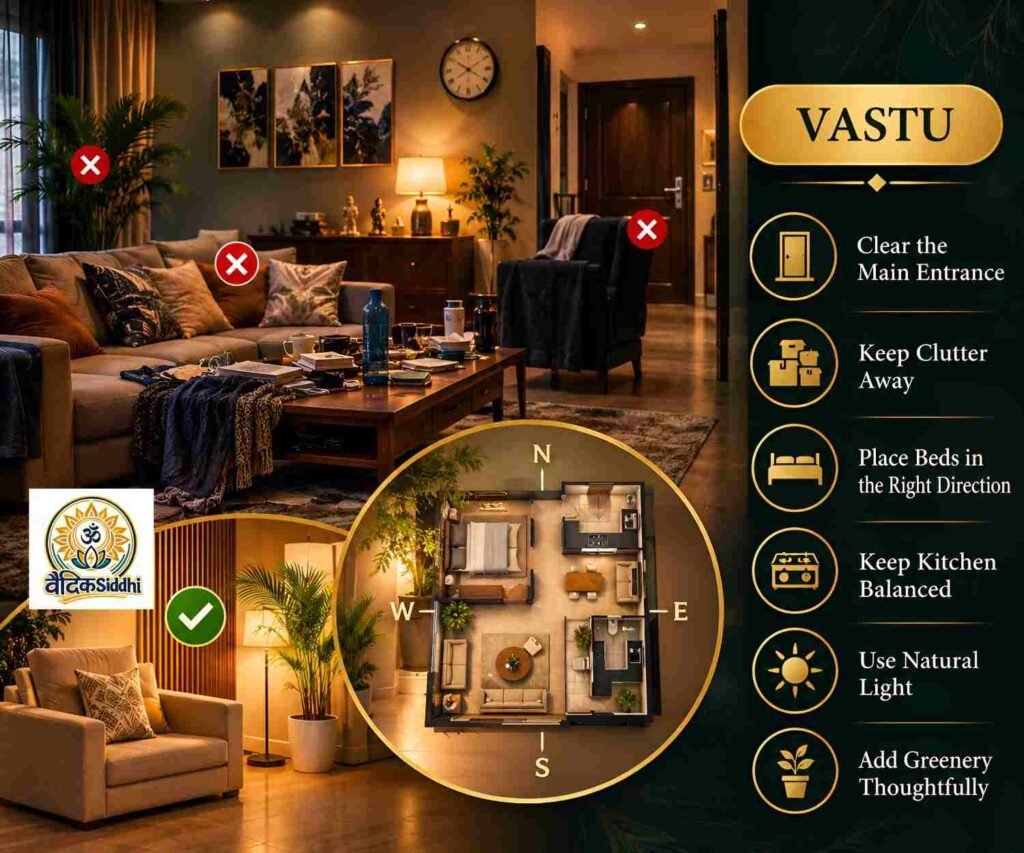
Both comfort and functionality affect the design of the house as well as its use. Learning about common Vastu mistakes would allow the homeowner to take into account the practical considerations like availability of light, proper ventilation, and an organized layout. This will make life easier and more comfortable for all residents of the house.
Knowledge of the most common Vastu Shastra mistakes can help homeowners with the layout of their home, and make practical changes to improve the feng shui of their abode. Homeowners should follow traditional design ideas in a practical way. They should consider local conditions, building design, and other limits before making changes to their homes.
The notion of Vastu Shastra should be applied consistently to all types of homes, whether flats in Delhi, builder floors in Noida, or independent houses in Gurgaon.
What Are the Most Common Vastu Mistakes in Indian Homes?
Incorporation of the wisdom of Vastu Shastra in architecture varies from case to case. This can be while buying a home, renovating a kitchen, rearranging furniture or even while shifting to a new house. There are different recommendations of Vastu Shastra for different places of the house.
When there is enough space for the main entrance and room doors, this makes it easier to move around and allows the natural light and fresh air to move freely in the house. The list of things to avoid to prevent common Vastu mistakes includes providing good ventilation in kitchens and other closed rooms. The direction of the room does not matter at all.
Knowledge of these practices can go a long way in improving the design of a home.
1. Paying No Attention to Main Entrance Direction and Layout
Traditionally, the placement of the main entrance is very important in Vastu Shastra. People often focus too much on the direction of the main entrance because it is the first entry point to the house. However, they often ignore its condition. For example, the entrance may have obstacles, poor lighting, or too many items around it.
In many apartments in Dwarka, Rohini and Greater Noida, the main entrance is usually in a designated location because of the plan of the building. This does not mean that the entire property needs to be reconstructed.
Some things that can be changed to improve Vastu of the main entrance include:
- Keep the main entrance clutter free.
- Move any objects that prevent the main entrance from opening fully.
- Keep the entryway clear.
- Check if there is adequate space to enter and exit the house if the main entrance is used by people with poor mobility.
In traditional Vastu, some systems of interpretation would endorse the use of a particular main entrance direction. Be wary of paying for an expensive main entrance wall re-alignment if the main entrance direction is changed.
2. Placement of the Kitchen Ignorant to Function
Of all the planning concerns related to Vastu Shastra, the placement of the kitchen tends to raise the most concerns. In Vastu, the southeast corner is often associated with the element of fire.
However, in many dwellings in Delhi NCR, the available space often constrains where the kitchen can be placed.
It’s a good idea to work on improving functionality before pursuing major remodels. While it is always ideal to maintain a well-functioning kitchen, there are a few best practices that should always be followed.
Primarily, make sure that the ventilation system is working, that there is sufficient counter space, that heat-producing appliances are not adjacent to combustible surfaces, and that frequently used utensils and equipment are within easy reach.
Furthermore, homeowners should evaluate if the positioning of the refrigerator, sink, and cooktop create an efficient work flow. Redesigning the workflow to incorporate these elements can improve the overall usability of the space.
3. Inefficient Bedroom Design
As with other rooms, Vastu principles specify optimal directions for each of the beds in the bedrooms. Traditionally, the main bedroom is often positioned in the southwest direction. There are a number of other variables that need to be taken into account in addition to these principles. For example, a particular apartment may suffer from the impacts of a busy street, or may not have adequate wardrobe and bedside spaces.
There may be other obstructions that limit the flow of a given space. For example, is the bed blocking the only source of light? A number of design solutions may help alleviate the discomfort and improve the quality of a given space, including noise reduction and cross ventilation.
A design professional who is trained in Vastu will help incorporate numerous design principles into an overall site plan. For the protection of the existing design, it is best to maintain safe, adequate, and adequate population circulation and to avoid speculative and needless adjustment of the physical constraints of the site.
4. Ignoring Natural Light and Air
It’s not uncommon to find a home with several recommendations aligned to different traditions, yet remain unsatisfied and uncomfortable due to lack of adequate natural light and cross ventilation. While looking into the reasons for such conditions, traditional planning needs to be differentiated from Vastu.
Traditional Vastu considers openings facing east and north good. However, the amount of natural light and fresh air depends on the size of the openings, the building’s direction, nearby buildings, and the time of year.
In layman terms, a room may not get natural light even if the room has an opening facing east or north due to the effects of surrounding obstructions. In such conditions, a number of design interventions may be undertaken to provide adequate internal light and improve the comfort level of the space.
Prioritize making adjustments to address air quality concerns and improve indoor environmental quality (e.g. by eliminating moisture and mold issues and improving ventilation) as opposed to making superficial changes (e.g. by modifying architectural details and finishes).
5. Placing Bathrooms and Toilets Without Assessing Constraints
Factors affecting the location of bathrooms and toilets in Vastu Shastra are comparable to those affecting other spaces in the built environment. While differences in points of view on preferred and avoided directions may exist, practical opportunities for flexibility in many floor plans are limited.
You can move a bathroom or toilet more easily in a new building. In an existing building, you may need permission from the building or housing society. Moving the plumbing can also cost a lot of money.
Prior to a renovation, have the plumbing inspected for leaks. Exhaust fans should ventilate to the outdoors. Seal drain traps to stop dirty water from flowing back into the building. If you install a light above a shower or bathtub, use a light made for wet areas and seal it properly.
If a toilet is located in a direction that is traditionally problematic in Vastu Shastra, a qualified consultant should evaluate other possible alternatives.
6. Neglecting the Center
In traditional understanding of Vastu Shastra, space in the center of the home is often associated with the Brahmasthan. Obstructions in this space may be restrictive.
In modern homes, the center of the house may include a passageway. It may not always be beneficial to provide an unobstructed center, or to configure space in a manner similar to old homes.
Adequate movement between different spaces of a home is a key element of good floor design. There is no value in having a central corridor of the home which is obstructed with no clear paths to other parts of the home.
This is most noticeable in builder designed homes. Some small changes to layout can improve the overall movement and congestion of a home.
7. Treating Every Vastu Concern as a Demolition Reason
Demolishing and rebuilding a home to fix every Vastu problem can cost a lot of money. Clients may get different advice from different people. Online Vastu checklists can also confuse them.
Classical Vastu rules and wisdom should be considered in the light of architecture and mechanical situation of the home and region. Financially providing for a solution to unblock a physical obstruction is a concern. Tradition and preferences should be assessed and prioritised in the context of architecture and good design practice.
Homeowners should consult a traditional Vastu expert to check their home’s design and layout. They should avoid spending money on changes they do not need.
How to Avoid Common Vastu Situations at Home
Most of the time, to improve a situation at home, a total renovation is not required. Take small, relatively inexpensive and easy to implement steps to create a large difference and sense of improvement. Only in extreme, unmanageable cases should extensive and large renovation steps be undertaken.
Vedic Siddhi suggest you begin by creating a site diagram showing the current condition of the property. Outline the issues that you see. Think about modifications that can be made to the property within its physical constraints.
Home Improvement Checklist
Floor Plan
Locate the entry, kitchen, bedrooms, bathrooms, windows, and the main pathways on your floor plan.
Identify Problems
Find problems with the current layout such as obstructed stairways, insufficient ventilation, noisy rooms, and unpleasant furnishings.
Prioritize
Determine if a given recommendation is absolutely necessary or if it’s a preference.
Consider changes that do not require the help of a professional. These may include reorganizing furnishings, decluttering and organizing, and improving lighting.
Think about what problems you have that may require the assistance of a professional.
For example –
Issues with the home that may require the help of a contractor to change walls or other potentially dangerous modifications would require an architect or engineer.
This guide can help you better understand the issues you may have with your home and provide a foundation for a discussion with a certified professional.
Process for Assessing Vastu of a Property
Homeowners often face many choices and need to make quick decisions. Some people who offer help may not fully understand the homeowner’s needs. The steps below will help homeowners check their property and make better decisions.
- Homeowners should find a rough property floor plan and/or elevations including approximate room sizes, as well as a picture of the subjects of concern. If the property is still in the design or planning stage, the homeowner should include the architectural drawings as well.
- Homeowners should determine the concerns that they want assessed (i.e. placement of various rooms, entrance location, obstructions, etc.)
- Homeowners should contact a qualified practitioner that will give them an assessment of the traditional aspects of Vastu, describe and assess the practicality of the recommendations made. Do not accept and implement a long list of recommendations made without explanation.
Step 1: Prioritise the Recommendations
Address safety, maintenance, access, and ventilation issues first. Make reversible adjustments to address Vastu concerns. Undertake major changes only when necessary.
Step 2: Estimate the Full Cost
Get estimates for the cost of all materials, labor and professional services. Estimate the costs of repairs. Obtain all required permits and determine whether any restrictions apply to the building.
Step 3: Review the Results
Ask yourself if the changes made to your home improved its usability, comfort and if it has facilitated the maintenance of a better and organized environment. Continuously assessing your environment and addressing new issues identified by each assessment is not recommended.
How Vedic Siddhi Can Help
Vedic Siddhi is a reliable source of information for traditional Vastu Services and for persons seeking property planning and layout advice. When seeking advice for your property, explain the issues you want to address and any limitations on renovation or construction. Your consultant should inform you about all relevant aspects.
A Vastu Consultant in India is obligated to guide you according to his/her expertise and should be able to combine the traditional school of Vastu along with practical building requirements and obligations. Do not be reluctant to question and clarify the recommendations provided.
Local conditions can be very important when considering Vastu for houses made up of multiple units like apartments, older houses and builder floors. Understanding architectural conditions and constraints of a house can help a homeowner locate and make internal modifications suitable to a house.
A Short Conversation about Common Vastu Mistakes
Question: How can I identify Common Vastu Mistakes without significant changes to my house?
Answer: Review the present condition of your house with respect to internal organization, flow and movement of air.
Question: Where can I learn Traditional Vastu?
Answer: Vedic Siddhi can help you in this regard.
Summary
It is very important to know about your home’s design, its needs, and finding out solutions. A Vastu Consultant in Delhi will help you understand the concept of Vastu Shastra while taking into consideration the structure of your home and its needs. In this way, you can follow the traditional concepts while at the same time giving importance to practicality.
When you reside in Delhi, Noida, Gurgaon, or other parts of our great country, unnecessarily spending your hard-earned money based on someone’s general opinion or fear is not wise. When you need to learn traditional knowledge of Vastu, you can share your house conditions, layout, and concerns with a knowledgeable Vastu consultant.
Some Important Questions
1. What Are the Important or Most Common Vastu Mistakes?
Most frequent important concerns are location of the main entrance, orientation of the kitchen, presence of clutter, central obstructions and good flow of air, among others.
2. Can Vastu Mistakes Be Corrected Without Demolition?
Yes, you can change several things without demolition, such as furniture arrangement, lighting, and storage. You can address traditional Vastu concerns when the house layout allows you to follow the relevant recommendations.
3. How Do I Choose a Vastu Consultant in India?
It is advisable to choose a Consultant who will consider the constraints of the property, and give recommendations keeping in view the client’s needs. It is important that recommendations of a Consultant do not guarantee the improvement of the financial or health status of the client.
4. Should I Consult a Vastu Consultant in Delhi Before Buying a Flat?
You can consider traditional Vastu recommendations before purchasing a property, especially if its layout has issues that you cannot modify. However, it is always important to carry out checks related to the legal status, the condition of the structure, the adequacy of ventilation and plumbing, etc. of the property.
5. Is Vastu Planning Necessary for Every Home in 2026?
Implementing traditional Vastu recommendations is not a mandatory requirement. Homeowners are free to implement traditional Vastu recommendations of their choice in conjunction with reasonable requirements of architecture, safety and usability.